
 Patient
 Doctor
 Digital Clinic

The short answer: most back pain, including pain from a slipped disc, settles within a few weeks to a few months without surgery. Staying gently active, the right pain relief, guided exercise and better sitting and lifting habits are the main treatments. See a doctor urgently if you have numbness around the groin or inner thighs, new difficulty passing urine or controlling your bowels, or a leg that is getting weaker. If your pain has lasted more than a few weeks, travels down a leg, or you have been advised spine surgery and want to understand your options, a consultation with a spine surgeon can help, and this can be done by video from anywhere in the world.
This guide explains the common causes of back pain, what a slipped disc, a disc prolapse and an L4-L5 disc bulge really mean, how sciatica behaves, which warning signs matter, how posture and ergonomics protect your spine, and what an online spine consultation can and cannot do.
Back pain at a glance
| Question | Answer |
|---|---|
| How common is it? | Very. The World Health Organization estimates that 619 million people were living with low back pain in 2020, and it is the leading cause of disability worldwide. |
| Is it usually serious? | Usually not. In about 9 out of 10 cases no specific disease or structural cause is found, and the pain improves with time and activity. |
| What is a slipped disc? | The soft centre of a spinal disc pushes out through its outer ring and may press on a nearby nerve. Doctors call it a herniated or prolapsed disc. |
| What is sciatica? | Pain, tingling or numbness that travels from the lower back or buttock down the leg, usually because a nerve root in the lower spine is irritated. |
| Which disc is affected most often? | The two lowest discs, L4-L5 and L5-S1, account for the large majority of slipped discs in the lower back. |
| Do most people need surgery? | No. Only a small percentage of people with a slipped disc need an operation. |
| When is it an emergency? | Numbness in the saddle area, loss of bladder or bowel control, weakness in both legs, or back pain after a serious injury. |
Common causes of back pain
The lower spine carries most of the body's weight and bends and twists all day, so it is the part of the back that hurts most often. These are the causes a spine doctor sees most frequently:
| Cause | Typical pattern |
|---|---|
| Muscle or ligament strain | Ache or stiffness across the lower back after lifting, a sudden movement or long sitting. Usually improves within days to a few weeks. |
| Slipped (herniated) disc | Back pain with sharp pain, tingling or numbness travelling down one leg (sciatica). Often worse on sitting, bending, coughing or sneezing. |
| Disc wear (degenerative disc disease) | On-and-off ache that is worse with long sitting and better with walking or changing position. |
| Lumbar canal stenosis | Usually after the age of 50: heaviness, pain or tingling in the legs on standing or walking that eases on sitting or bending forward. |
| Spondylolisthesis | One spinal bone slips forward on the one below, causing back pain that is worse on standing and bending backwards, sometimes with leg pain. |
| Facet or sacroiliac joint pain | Pain to one side of the lower back or buttock, worse on getting up from a chair or turning in bed. |
| Osteoporotic fracture | Sudden back pain in an older adult, sometimes after a minor fall or even a cough. |
| Inflammatory back pain | Usually starts before the age of 40: morning stiffness lasting more than 30 minutes that improves with movement, not rest. |
| Infection or tumour (rare) | Constant pain that is worse at night, with fever, weight loss or a past history of cancer. Needs prompt assessment. |
Slipped disc, disc bulge and disc prolapse: what the words mean
Between each pair of spinal bones (vertebrae) sits a disc: a tough outer ring with a soft, gel-like centre. Discs act as shock absorbers and let the spine bend. A disc does not actually "slip" out of place. What people call a slipped disc is the centre of the disc pushing outwards through a weak area in the outer ring.
MRI reports use several words for this, and they describe different degrees of the same process:
| Word on the MRI report | What it means in plain language |
|---|---|
| Disc desiccation or degeneration | The disc has lost some water and height. This is a normal age-related change, like grey hair, and is often painless. |
| Disc bulge | The disc spreads out evenly beyond the edge of the bone, like a slightly flattened tyre. Very common and often not the cause of pain. |
| Disc protrusion | A focal part of the disc pushes out further, but the outer ring is still intact. This is the usual "slipped disc". |
| Disc extrusion | The soft centre has broken through the outer ring. More likely to irritate a nerve. |
| Sequestration | A fragment has separated from the disc. These fragments often shrink on their own over time. |
| Disc prolapse or herniation | General terms that cover protrusion, extrusion and sequestration. |
| Nerve root compression or foraminal narrowing | The disc, or bone and ligament around it, is pressing on a nerve where it leaves the spine. |
An important point: disc changes on an MRI are extremely common in people with no pain at all. A review of scans of pain-free adults found disc bulges in about 30% of 20-year-olds, 60% of 50-year-olds and 84% of 80-year-olds. This is why a scan must always be read together with your symptoms and an examination. The finding matters only when it matches the pattern of your pain.
The L4-L5 disc and the L5-S1 disc: why these two levels
The lumbar spine has five vertebrae, numbered L1 to L5, sitting on the sacrum (S1). The L4-L5 disc lies between the fourth and fifth lumbar vertebrae, roughly at the level of the top of your hip bones. The L5-S1 disc is the one below it. These two discs carry the greatest load and allow the most bending, so they are where most lumbar slipped discs occur.
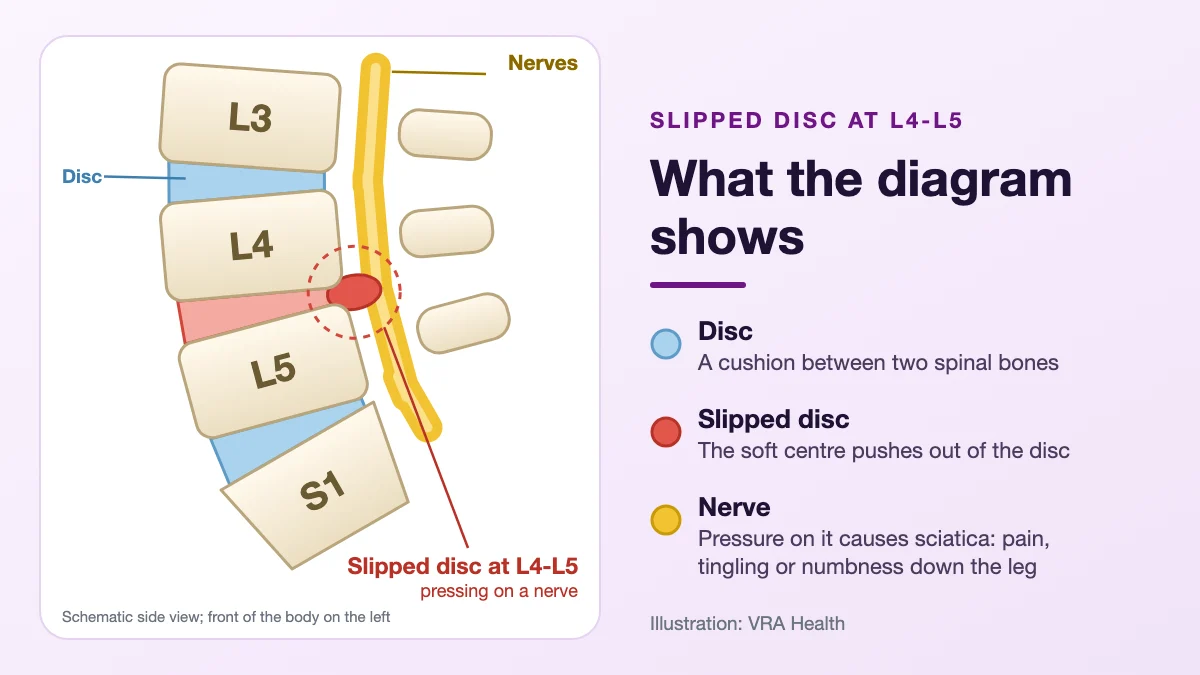
A slipped disc at L4-L5: the soft centre of the disc pushes backwards and presses on a nearby nerve.
Which nerve is irritated decides where you feel the symptoms:
| Disc level | Nerve usually affected | Typical symptoms |
|---|---|---|
| L3-L4 | L4 | Pain to the front of the thigh and inner shin; the knee may feel weak on stairs. |
| L4-L5 | L5 | Pain from the buttock down the outer leg to the top of the foot and big toe; difficulty lifting the foot or big toe, or walking on the heels. |
| L5-S1 | S1 | Pain down the back of the thigh and calf to the outer edge or sole of the foot; difficulty standing on tiptoe. |
If your MRI report mentions an "L4-L5 disc bulge" and you have only mild central back ache with no leg symptoms, the bulge may be an incidental finding. If you have pain down the outer leg with a weak foot on the same side, it is far more likely to be the cause. Sorting out which is which is a large part of what a spine consultation is for.
Sciatica: symptoms, causes and how long it lasts
Sciatica is not a diagnosis in itself. It describes pain that follows the path of the sciatic nerve, from the lower back or buttock down the back or side of the leg, sometimes to the foot. It is usually felt in one leg, and the leg pain is often worse than the back pain. Tingling, numbness, a burning feeling or weakness in the leg or foot can come with it.
The most common cause in adults under 50 is a slipped disc at L4-L5 or L5-S1. In older adults, narrowing of the spinal canal (stenosis) is more common. Less often, a tight muscle deep in the buttock or a slipped vertebra is responsible.
Sciatica usually improves within four to six weeks, although it can last longer. Most people with a slipped disc are free of symptoms by three to four months, because the body gradually absorbs the disc material that has pushed out and the inflammation around the nerve settles.
Warning signs: when back pain is an emergency
Go to the nearest emergency department straight away if you have back pain with any of the following. They can be signs of cauda equina syndrome, in which the nerves at the bottom of the spine are severely compressed, and it needs treatment within hours:
- Numbness or tingling around the genitals, anus, buttocks or inner thighs (the "saddle" area)
- New difficulty starting to pass urine, not feeling that your bladder is full, or leaking urine
- Loss of bowel control or not feeling when you pass stool
- Weakness or sciatica in both legs, or a leg that is rapidly getting weaker
See a doctor in person promptly if you have back pain with:
- A fall, road accident or other significant injury
- Fever, feeling unwell, or unexplained weight loss
- A history of cancer, osteoporosis, long-term steroid use or a weakened immune system
- Pain that is constant, worse at night and not eased by changing position
- A foot that drags or catches on the ground (foot drop)
- Pain that began before the age of 20 or for the first time after the age of 55
A video consultation is not suitable for these situations.
Do I need an MRI or X-ray for back pain?
Usually not in the first few weeks. Guidelines from bodies such as the UK's National Institute for Health and Care Excellence advise against routine scans for low back pain, because the result rarely changes the early treatment and incidental findings can cause unnecessary worry. An MRI is useful when:
- Any of the warning signs above are present
- Sciatica or weakness has not improved after about six weeks of treatment
- An injection or surgery is being considered and the doctor needs to see the exact level
An X-ray shows the bones and the alignment of the spine but does not show discs or nerves. An MRI shows discs, nerves and the spinal canal and uses no radiation.
Treatment for back pain and a slipped disc without surgery
For most people, treatment is about controlling pain while the body heals and then rebuilding strength so that the problem is less likely to return.
- Keep moving. Long bed rest slows recovery. Short walks several times a day and a gradual return to normal activity are better than lying down, even if some pain remains.
- Heat. A warm pack on the lower back for 15 to 20 minutes can ease muscle spasm.
- Pain relief. A short course of anti-inflammatory medicine may help if it is safe for you. Ask a doctor or pharmacist first, particularly if you have stomach, kidney or heart problems, take blood thinners or are pregnant. For nerve pain, a doctor may prescribe other medicines after assessing you.
- Physiotherapy and guided exercise. A programme of stretching, core strengthening and movement retraining, adjusted to your condition, is the mainstay of treatment for pain that lasts beyond a few weeks.
- Changing how you sit, lift and work. See the posture and ergonomics section below.
- Spinal injections. For severe sciatica that is not settling, an epidural or nerve root steroid injection can reduce inflammation around the nerve and give relief while natural healing continues.
- Sleep, stress and weight. Poor sleep, low mood, smoking and excess weight all make back pain last longer, and are worth addressing alongside everything else.
Belts and braces can be used for a short time in specific situations, but long-term use is generally not advised because the supporting muscles weaken.
When is spine surgery considered?
Surgery is the exception, not the rule. A spine surgeon will usually discuss an operation when:
- There are signs of cauda equina syndrome (this is an emergency)
- Weakness in the leg or foot is significant or getting worse
- Severe sciatica has not improved after about six to twelve weeks of proper non-surgical treatment, and the MRI shows a disc pressing on the matching nerve
- Spinal stenosis or a slipped vertebra is limiting walking and daily life despite treatment
The commonest operation for a slipped disc is a discectomy, in which the part of the disc pressing on the nerve is removed, often through a small incision with a microscope or endoscope. For instability or a slipped vertebra, a fusion may be discussed. Every operation has benefits and risks, and these depend on your age, general health, the exact problem and how long the nerve has been compressed. If you have been advised surgery and are unsure, a second opinion is reasonable and most surgeons welcome it.
Posture and ergonomics: how to protect your spine every day
There is no single "perfect" posture. The spine is built to move, and the bigger problem is staying in any one position for too long. The aim is a comfortable, supported position and frequent changes.
At a desk
- Sit back in the chair so that your lower back is supported. A small cushion or rolled towel in the curve of the lower back helps.
- Keep your feet flat on the floor or on a footrest, with your knees at about hip level.
- Place the top of the screen at or just below eye level, about an arm's length away.
- Keep the keyboard and mouse close, with elbows near your sides and bent to about 90 degrees.
- If you work on a laptop for hours, raise it on a stand or a stack of books and use a separate keyboard and mouse.
- Stand up, stretch or walk for a minute or two every 30 minutes. Set a reminder if you tend to forget.
- If you use a standing desk, alternate between sitting and standing instead of standing all day.
Lifting and carrying
- Stand close to the object, bend at the hips and knees, and keep the load close to your body.
- Do not twist while lifting. Turn with your feet.
- Split heavy loads, and ask for help with anything awkward. Use a backpack with both straps, or a suitcase with wheels.
Driving and flying
- Sit close enough to the pedals that your knees stay slightly bent, with the seat back only slightly reclined and your lower back supported.
- On long drives, stop every one to two hours to walk and stretch.
- On long-haul flights, use a small cushion behind the lower back, and stand up and walk the aisle regularly.
Phone, sofa and bed
- Raise your phone or tablet towards eye level instead of bending your neck over it for long periods.
- Avoid working for hours on a sofa or bed with the laptop on your lap.
- Choose a mattress that supports you without sagging. If you sleep on your side, a pillow between the knees keeps the spine level; on your back, a pillow under the knees can ease the lower back.
Exercise is the best protection
A review of clinical trials found that exercise programmes, alone or combined with education, lowered the risk of a new episode of low back pain by roughly a third to a half over the following year. Walking, swimming, cycling, yoga and exercises that strengthen the core, back and hip muscles all count. Pick something you will keep doing. If you already have pain or a known disc problem, ask a doctor or physiotherapist which exercises suit you before starting.
Can a spine doctor help on a video consultation?
On a video consultation, a spine surgeon can: take a detailed history of your pain, review your MRI or X-ray report and images with you, watch you stand, bend and walk on camera, guide you through simple checks such as walking on your heels and toes, explain the likely diagnosis in plain language, tell you whether your scan findings match your symptoms, plan treatment and exercises, advise whether an injection or surgery is worth considering, and give a second opinion on surgery that has been recommended.
A video consultation cannot: replace a hands-on examination of muscle power, reflexes and sensation, deal with an emergency, or deliver physiotherapy, injections or surgery. If the doctor feels you need to be examined in person or need a scan, they will tell you so that you can arrange it where you live.
Living abroad? Consulting an Indian spine surgeon online
Many Indians living in the USA, UK, Canada, Australia, the UAE and other countries use a video consultation with a spine surgeon in India for reasons like these:
- Understanding an MRI report. You have a report that mentions an L4-L5 disc bulge or nerve compression and want it explained clearly, in your own language.
- A second opinion before surgery. You have been advised a discectomy or fusion and want an independent view of whether it is needed now and what the alternatives are.
- Waiting times. In some health systems the wait to see a spine specialist can run to weeks or months. A video consultation in the meantime can tell you what is safe to do and which symptoms should not wait.
- Planning care around a trip to India. If you are considering physiotherapy, an injection or an operation in India, a consultation beforehand helps you plan the time you will need.
- Parents in India. You can book for a parent with back or leg pain and join the call from your own time zone.
On VRA Health, appointment slots are shown in your local time with Indian time alongside, and the full fee is shown in your own currency before you book. Read more about online doctor consultations for NRIs.
Prescriptions outside India. Where it is medically appropriate, the doctor issues a digital prescription in your account. Pharmacies outside India usually do not accept a prescription from a doctor registered in India, so treat it as professional medical advice and check your local rules; you may need a local doctor to prescribe the medicine. A second opinion does not replace the doctor treating you in person, but it helps you make an informed decision.
How to prepare for an online spine consultation
- Keep your MRI or X-ray report ready, and the images too if you have them on a disc, a link or a patient portal.
- Write down the story: when the pain started, where it travels, what makes it better or worse, and any numbness or weakness.
- List your medicines and the treatments you have tried, including physiotherapy and injections.
- Note your other health conditions, such as diabetes, blood pressure, osteoporosis or past surgery.
- Set up the camera so the doctor can see you standing and walking a few steps, in a room with good light, and wear comfortable clothes.
- Write down your questions, for example "Do I need surgery?", "Which exercises are safe?" and "When can I return to the gym or to work?".
How to book a video consultation with a spine surgeon on VRA Health
- Open the profile of Dr. Sudheer Kumar Pothu, orthopaedic and spine surgeon, or browse all doctors on the online orthopaedic consultation page. You can also use the VRA Health app from the App Store or Google Play.
- Choose a slot. Times are shown in your local time zone.
- Send your request. You pay online, in your currency, only after the doctor accepts.
- Join the video consultation at the booked time with your reports ready.
- Find your notes and any digital prescription in your account after the call.
You can also send "Hi" on WhatsApp to +91 86886 34366 to book.
Frequently asked questions
Can a slipped disc heal without surgery?
Yes, in most people. The body gradually absorbs the disc material that has pushed out and the nerve inflammation settles. Most people improve within a few weeks and are free of symptoms by three to four months. Only a small percentage need surgery.
What is the difference between a disc bulge and a slipped disc?
A disc bulge is a general, even spreading of the disc beyond the bone and is very common in people with no pain. A slipped disc, also called a herniated or prolapsed disc, is a focal push of the disc's soft centre through its outer ring, which is more likely to press on a nerve and cause sciatica.
What are the symptoms of an L4-L5 disc problem?
Lower back pain with pain, tingling or numbness that runs from the buttock down the outer side of the leg to the top of the foot and big toe. Some people find it hard to lift the foot or big toe or to walk on their heels. Many people with an L4-L5 disc bulge on MRI have no symptoms at all.
How long does sciatica take to get better?
Sciatica usually improves within four to six weeks, though it can last longer. See a doctor if it is severe, is not improving after a few weeks, or comes with weakness, numbness in the saddle area or bladder or bowel changes.
Is walking good for a slipped disc and sciatica?
Yes. Short, regular walks on level ground keep the back moving and are generally better than bed rest. Start with a few minutes several times a day and increase gradually. Stop and seek advice if walking brings on new weakness or numbness.
Is bed rest good for back pain?
No. A day or two of taking it easy is fine when pain is severe, but longer bed rest stiffens the back, weakens muscles and delays recovery. Gentle activity is recommended.
Do I need an MRI for back pain?
Not usually in the first few weeks. An MRI is advised when there are warning signs, when sciatica or weakness is not improving after about six weeks, or when an injection or surgery is being planned.
Which sitting posture is best for the lower back?
One in which your lower back is supported, your feet are flat on the floor, your knees are at about hip level and the screen is at eye level. More important than any single posture is changing position and standing up every 30 minutes.
When is surgery needed for a slipped disc?
Surgery is considered for cauda equina syndrome, for significant or worsening weakness, or when severe sciatica has not improved after about six to twelve weeks of proper non-surgical treatment and the MRI shows a disc pressing on the matching nerve.
Can I consult an Indian spine surgeon online from the USA, UK, UAE, Canada or Australia?
Yes. VRA Health connects patients in any country with doctors in India by private video call. Slots are shown in your local time and the full fee is shown in your currency before you book.
Can I get a second opinion on spine surgery by video consultation?
Yes. Share your MRI report, images and the treatment you have been advised. The spine surgeon reviews them with you on the call and explains the options. A second opinion does not replace the doctor treating you in person, but it helps you make an informed decision.
When is back pain an emergency?
Go to an emergency department if back pain comes with numbness around the genitals or inner thighs, loss of bladder or bowel control, weakness in both legs, a rapidly weakening leg, or follows a serious injury.
About the author
Dr. Sudheer Kumar Pothu is a consultant orthopaedic and spine surgeon in Hyderabad with over 12 years of experience. His qualifications are MBBS, D.Ortho, DNB (Orthopaedics) and FNB (Spine Surgery), with his spine surgery fellowship at Sakra World Hospital, Bengaluru. Medical registration number: APMC/FMR/73155. He sees patients with back and neck pain, slipped disc, sciatica, spinal stenosis, spinal fractures and osteoporosis, and gives second opinions on spine surgery. He consults in English, Telugu, Hindi, Tamil and Kannada.
Book a video consultation with Dr. Sudheer Kumar Pothu.
Sources
- World Health Organization. Low back pain: fact sheet.
- National Institute for Health and Care Excellence (UK). Low back pain and sciatica in over 16s: assessment and management (NG59).
- American Academy of Orthopaedic Surgeons. Herniated disk in the lower back and Cauda equina syndrome.
- NHS (UK). Sciatica and Slipped disc.
- Brinjikji W, et al. Systematic literature review of imaging features of spinal degeneration in asymptomatic populations. American Journal of Neuroradiology, 2015.
- Steffens D, et al. Prevention of low back pain: a systematic review and meta-analysis. JAMA Internal Medicine, 2016.
This article is for general health education and does not replace a consultation with a doctor who can assess you. Do not start, stop or change any treatment on the basis of this article alone. In an emergency, go to the nearest hospital.