
 Patient
 Doctor
 Digital Clinic


✓ Medically reviewed Written and reviewed by Dr. Pandu Chouhan, MD, FIG, FIGE, Pediatric Gastroenterologist (trained at AIIMS, New Delhi). Last reviewed: 27 November 2026.
The short answer: most stomach pain in children is not dangerous. Constipation, gas, a stomach infection or a sensitive gut cause the large majority of tummy aches, and they settle with rest, fluids, the toilet and time. Take your child to a hospital at once if the pain is severe and getting worse, moves to the lower right side of the tummy, comes with green or blood-stained vomit, blood in the stool, a hard swollen tummy, or a child who is drowsy and will not move. If the pain keeps coming back for weeks, wakes your child from sleep, or comes with weight loss or poor growth, see a pediatric gastroenterologist, a doctor who specialises in children's stomach, intestine and liver problems.
This guide explains, in plain language, why children get stomach pain, what the place of the pain can tell you, the warning signs you should never ignore, what you can safely do at home, and when a specialist can help. It is written for parents and carers of babies, children and teenagers.
Stomach pain in children at a glance
| Question | Answer |
|---|---|
| How common is it? | Very common. Almost every child has a tummy ache at some time, and about 1 in 7 school-age children worldwide has stomach pain that keeps coming back. |
| Is it usually serious? | No. In most children no dangerous cause is found. Fewer than 1 in 10 children with long-lasting tummy pain have a disease that needs special treatment. |
| What are the commonest causes? | Constipation, gas and indigestion, stomach infection (loose motions and vomiting), and functional abdominal pain (a sensitive gut). |
| Which pain is an emergency? | Severe pain that keeps getting worse, pain in the lower right tummy, green vomit, blood in vomit or stool, a hard swollen tummy, or a very sleepy or pale child. |
| What can I do at home? | Rest, sips of fluid or ORS, light food, a warm (not hot) pack on the tummy, and a relaxed sit on the toilet. |
| Which medicines should I avoid? | Aspirin, adult antacids and painkillers, leftover antibiotics, and laxatives or anti-diarrhoea medicines unless a doctor has advised them. |
| Who treats tummy pain that keeps coming back? | A pediatrician first. A pediatric gastroenterologist if the pain lasts more than a few weeks or there are warning signs. |
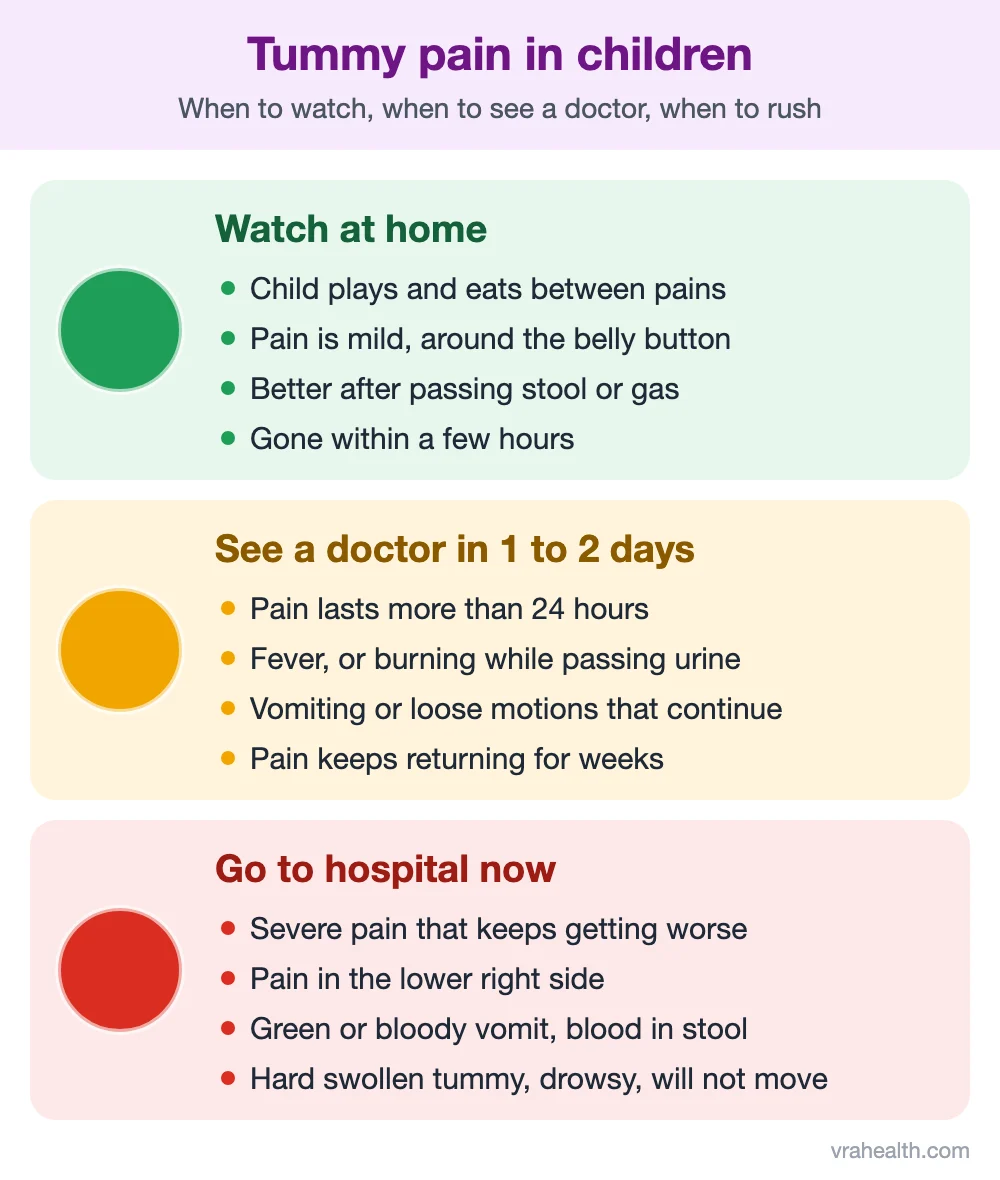
A quick guide for parents: when to watch at home, when to book a doctor, and when to go to a hospital.
Why do children get stomach pain?
Doctors call it abdominal pain. Parents call it stomach pain, tummy pain, tummy ache or stomach ache. They all mean pain felt anywhere between the chest and the groin. That area holds the stomach, the small and large intestine, the liver, the gallbladder, the pancreas, the kidneys and the bladder, so many different things can cause pain there.
Young children cannot describe pain well. A child under about 6 years will usually point to the belly button whatever the cause. Some children say "my tummy hurts" when they really feel sick, hungry, worried or need the toilet. So how your child looks and behaves often tells you more than the words. A child who is playing, eating and smiling between bouts of pain is rarely seriously ill. A child who lies still, looks pale, cries when moved or refuses to walk needs a doctor quickly.
Common causes of stomach pain in children
| Cause | What you usually see |
|---|---|
| Constipation | Hard, large or painful stools, or fewer than 3 stools a week. Pain comes and goes, often after meals, and is better after passing stool. The most common cause of tummy pain that keeps coming back. |
| Gas, overeating or indigestion | Bloated tummy, burping or passing wind, pain after a heavy, oily or spicy meal or fizzy drinks. Settles in a few hours. |
| Stomach infection (gastroenteritis) | Loose motions, vomiting, cramps and sometimes fever, often with others at home or school sick too. Usually caused by a virus and lasts a few days. |
| Functional abdominal pain (sensitive gut) | Pain around the belly button that comes and goes for weeks or months in a child who is growing well and has normal tests. |
| Acidity or gastritis | Burning pain in the upper tummy, sour burps, feeling sick, pain when hungry or after spicy food. |
| Urine infection | Pain low in the tummy or in the side, burning or frequent urine, fever, bed-wetting that has newly started. |
| Worms | Itching around the bottom at night (threadworm), mild tummy discomfort. Heavy roundworm infection can cause pain and poor weight gain. |
| Throat and chest infections | Sore throat, cold or cough with tummy pain. The glands inside the tummy swell during viral infections (doctors call this mesenteric adenitis). |
| Milk (lactose) intolerance or other food reactions | Bloating, gas and loose stools 30 minutes to 2 hours after milk, ice cream or a particular food. |
| Worry, stress or school problems | Pain on school mornings or before exams, better on weekends and holidays. The pain is real, not pretended. |
| Period pain | Cramps low in the tummy in girls around the time of periods, sometimes starting a few months before the first period. |
| Appendicitis and other surgical problems | Uncommon but urgent. Pain that steadily gets worse over hours. See the warning signs below. |
Causes of tummy pain by age
| Age | Common causes | Do not miss |
|---|---|---|
| Babies under 1 year | Colic, gas, constipation after starting solids, reflux, cow's milk protein allergy, stomach infection | Intussusception (bowel folding into itself), a hernia that is stuck, twisted bowel, urine infection |
| Toddlers and preschool children (1 to 5 years) | Constipation, stomach infection, viral illness, urine infection, swallowed air or overeating | Intussusception, appendicitis, a swallowed object such as a button battery or magnet |
| School-age children (6 to 12 years) | Constipation, functional abdominal pain, stomach infection, acidity, worms, urine infection | Appendicitis, coeliac disease, inflammatory bowel disease, diabetes |
| Teenagers | Functional pain and irritable bowel syndrome, acidity, constipation, period pain | Appendicitis, inflammatory bowel disease, gallstones, pancreatitis, twisted testis or ovary |
A note on colic: a healthy baby under 3 to 4 months who cries for more than 3 hours a day, on more than 3 days a week, usually in the evening, and feeds and gains weight well, probably has colic. It is exhausting for parents but harmless, and it passes by about 4 months of age. A baby with fever, green vomit, blood in the stool, a swollen tummy or poor feeding does not have colic and needs a doctor the same day.
Where is the pain? What the location can tell you
If your child is old enough, ask them to point with one finger to where it hurts most. The place of the pain is a useful clue, although it is never the whole answer.
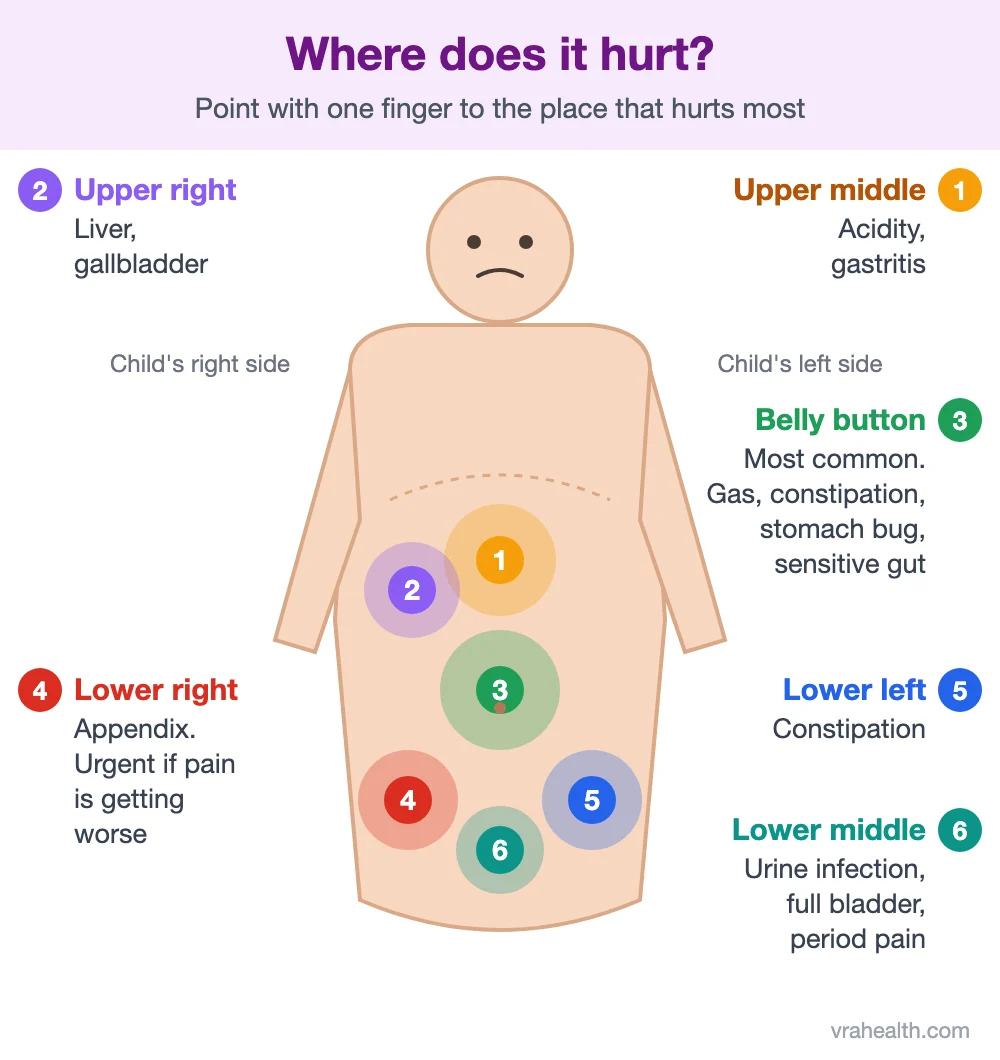
Tummy pain map. "Right" and "left" mean the child's right and left.
| Where it hurts | Common reasons |
|---|---|
| Around the belly button | The commonest place. Gas, constipation, stomach infection, functional pain. Early appendicitis can also start here before moving to the lower right. |
| Upper middle (below the breastbone) | Acidity, gastritis, indigestion. Rarely, an ulcer or pancreatitis. |
| Upper right | Liver or gallbladder problems. Sometimes a chest infection at the base of the right lung. |
| Lower right | Appendicitis until a doctor says otherwise, especially if the pain is getting worse and your child does not want to walk or jump. |
| Lower left | Most often constipation. |
| Lower middle (above the pubic bone) | Urine infection, a full bladder, constipation, period pain. |
| Side or back, below the ribs | Kidney infection or a kidney stone. |
| Groin or scrotum in a boy | A hernia or a twisted testis. This is an emergency. |
As a rough rule, the further the pain is from the belly button, the more likely it is to have a specific cause that a doctor should look for.
Warning signs: when stomach pain in a child is an emergency
Go to the nearest hospital emergency department now (in India you can call 108) if your child has stomach pain with any of these:
- Severe pain that is steadily getting worse, or pain so bad that your child cannot move, walk or be distracted
- Pain that has moved to, or stays in, the lower right side of the tummy
- Green (bile-coloured) vomit, or vomit with blood or that looks like coffee grounds
- Blood in the stool, black tarry stool, or stool that looks like red jelly
- A hard, swollen tummy that hurts to touch
- A baby who screams in bouts, pulls the legs up and looks pale and floppy in between
- Pain or swelling in the groin or scrotum
- Signs of dehydration: no urine for 8 hours or more, dry mouth, no tears, sunken eyes, unusual sleepiness
- Stomach pain after a fall, a road accident or a blow to the tummy
- Very drowsy, confused, breathing fast, or passing a lot of urine and very thirsty (this can be diabetes)
- A swallowed button battery, magnets or a sharp object
- Fever of 38°C (100.4°F) or more in a baby under 3 months
See a doctor within a day or two if:
- The pain has lasted more than 24 hours, or keeps returning over several days
- There is fever with tummy pain, or burning or frequent urine
- Vomiting lasts more than 24 hours or loose motions last more than 3 days
- Your child is eating and drinking much less than usual
- The skin or the whites of the eyes look yellow (jaundice)
Could it be appendicitis?
Appendicitis is the commonest reason for emergency tummy surgery in children. It is most frequent in school-age children and teenagers but can happen at any age. The typical story is:
- Pain starts around the belly button, then over some hours moves to the lower right side and stays there
- The pain gets steadily worse and is sharper when the child walks, coughs, jumps or goes over a speed-breaker in a car
- Loss of appetite, feeling sick or vomiting that starts after the pain
- Mild fever
- The child lies still and does not want anyone to press the tummy
Young children often do not follow this pattern, so do not wait for every sign. Do not give food, a laxative or strong painkillers at home if you suspect appendicitis. Take your child to a hospital. Treated early, appendicitis is cured with a short operation. A burst appendix is far more serious.
Tummy pain that keeps coming back: functional abdominal pain
Many parents search for answers because their child complains of stomach pain every day or every week, yet scans and blood tests are normal. A review of 58 studies covering almost 200,000 children found that about 13.5% of children worldwide, roughly 1 in 7, have this kind of pain. Doctors call it a functional abdominal pain disorder, or a disorder of gut-brain interaction.
"Functional" does not mean imaginary. The pain is real. The gut and the brain talk to each other all the time through nerves. In these children the nerves of the gut have become extra sensitive, often after a stomach infection, a period of constipation or a stressful time. Normal events such as food moving through the intestine, gas or a full bowel are then felt as pain. Worry and poor sleep turn the volume up further, and pain in turn causes more worry.
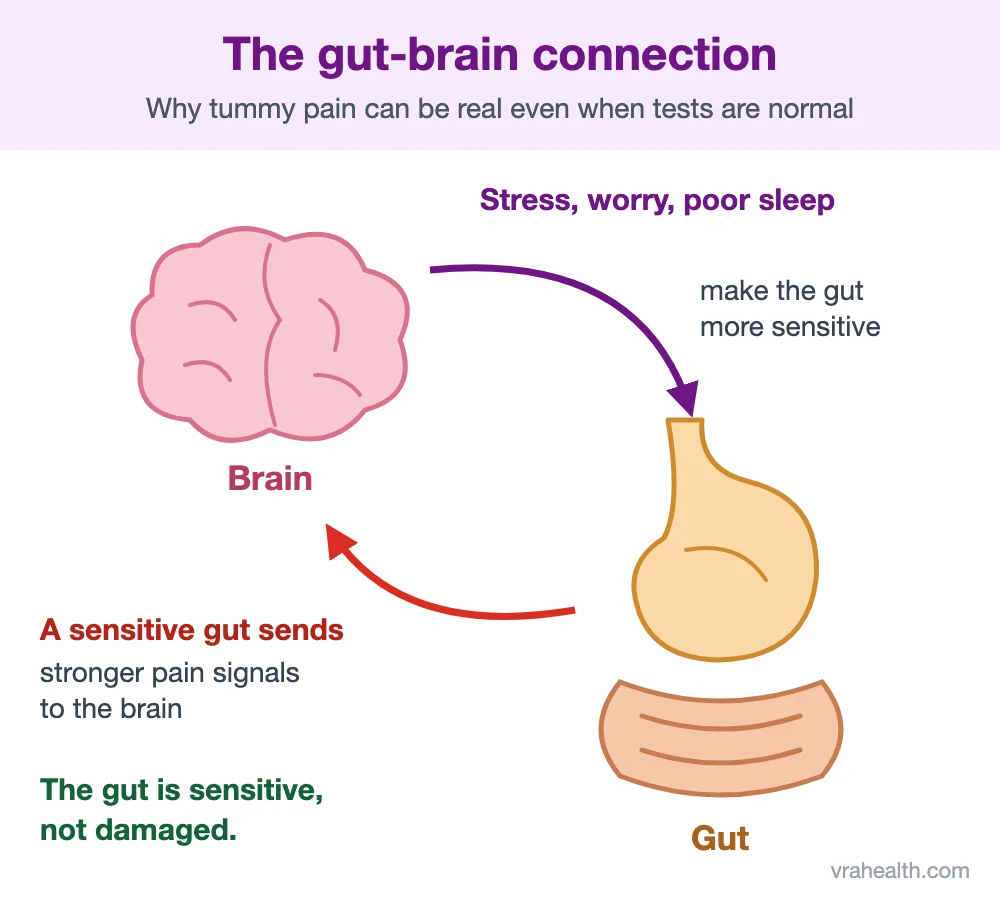
The gut and the brain are connected by nerves. In functional abdominal pain the gut is sensitive, not damaged.
Specialists use an international checklist called the Rome IV criteria to recognise four main patterns:
| Type | Typical pattern |
|---|---|
| Functional abdominal pain | Pain around the belly button at least 4 times a month for 2 months or more, not linked only to eating, periods or passing stool. |
| Irritable bowel syndrome (IBS) | Tummy pain linked to passing stool, with a change in how often the child goes or how the stool looks (loose, hard, or both). |
| Functional dyspepsia | Upper tummy pain or burning, feeling full very quickly, bloating or nausea after meals. |
| Abdominal migraine | Sudden attacks of strong pain around the belly button lasting an hour or more, with a pale face, nausea or vomiting, and completely well for weeks in between. Often a family history of migraine. |
What helps: a clear explanation and reassurance, treating any constipation, regular meals and sleep, going back to school and normal activity even if some pain remains, and relaxation or talking therapies such as cognitive behavioural therapy. Some children are helped by changes in diet or by medicines chosen by the specialist. Most children improve over months. You can read more from the pediatric gastroenterology society NASPGHAN (GIKids).
Red flags. Recurring pain is less likely to be functional, and needs tests, if your child also has any of these:
- Pain that wakes the child from sleep
- Pain that stays in the upper right or lower right of the tummy
- Weight loss, poor growth or delayed puberty
- Repeated vomiting, or difficulty or pain on swallowing
- Loose stools for weeks, stools at night, or blood in the stool
- Unexplained fever, mouth ulcers, joint pain or sores around the bottom
- A close relative with coeliac disease, inflammatory bowel disease or stomach ulcers
Is your child's tummy pain coming back again and again? You can book a video consultation with Dr. Pandu Chouhan, pediatric gastroenterologist, on VRA Health and discuss your child's symptoms and reports from home.
Constipation: the hidden cause of many tummy aches
Parents are often surprised when the doctor says the pain is from constipation, because the child "goes every day". A child can pass small amounts daily and still be holding a large load of hard stool. Suspect constipation if your child:
- Passes hard, dry, pellet-like or very large stools, or strains and cries
- Passes stool fewer than 3 times a week
- Stands stiffly, crosses the legs or hides to avoid going (this is holding stool in, not trying to push)
- Has stains of stool in the underwear
- Has tummy pain that eases after a big stool
Treatment is simple but needs patience. Doctors usually prescribe a stool softener, which is safe for children and often needed for several months, together with a toilet routine: sitting on the toilet for 5 to 10 minutes after meals with the feet supported on a stool. Add water, fruit, vegetables, dals and whole grains. Stopping the medicine too early is the most common reason constipation returns. The US National Institute of Diabetes and Digestive and Kidney Diseases and the UK NICE guideline on constipation in children give the same advice.
Loose motions and vomiting: stomach infection
A stomach infection (gastroenteritis, often called stomach flu) causes cramping pain with loose motions, vomiting and sometimes fever. Most cases are caused by viruses and get better in 3 to 7 days without antibiotics. The danger is not the pain but the loss of water and salts.
- Give oral rehydration solution (ORS) in small, frequent sips, about a spoonful or a sip every 1 to 2 minutes if your child is vomiting
- Continue breastfeeding and normal home food in small amounts. There is no need to starve the tummy
- The World Health Organization recommends ORS together with zinc for 10 to 14 days for diarrhoea in children. Ask your doctor about the dose
- Avoid fizzy drinks, packaged fruit juice and anti-diarrhoea medicines
See a doctor the same day if your child cannot keep fluids down, passes very little urine, has blood in the stool, has a high fever, or is under 6 months old.
Less common causes a pediatric gastroenterologist looks for
- Coeliac disease: a reaction to gluten in wheat, barley and rye. It causes tummy pain, bloating, loose stools or constipation, poor growth and anaemia. It is common in North India. A blood test is the first step. Do not remove wheat from the diet before testing, because that can hide the result. More from NIDDK.
- Inflammatory bowel disease (Crohn's disease and ulcerative colitis): long-lasting inflammation of the intestine, with pain, loose stools with blood or mucus, weight loss, tiredness and mouth ulcers.
- Helicobacter pylori infection and ulcers: a germ that lives in the stomach lining and can cause gastritis or ulcers, with upper tummy pain, nausea or vomiting.
- Lactose intolerance: difficulty digesting the sugar in milk, causing gas, bloating and loose stools after milk products. It can appear for a few weeks after a stomach infection.
- Pancreatitis: strong pain in the upper tummy that may go through to the back, with vomiting. It needs hospital care.
- Gallstones and liver problems: pain in the upper right tummy, sometimes with yellow eyes or dark urine.
What to do at home when your child has a tummy ache
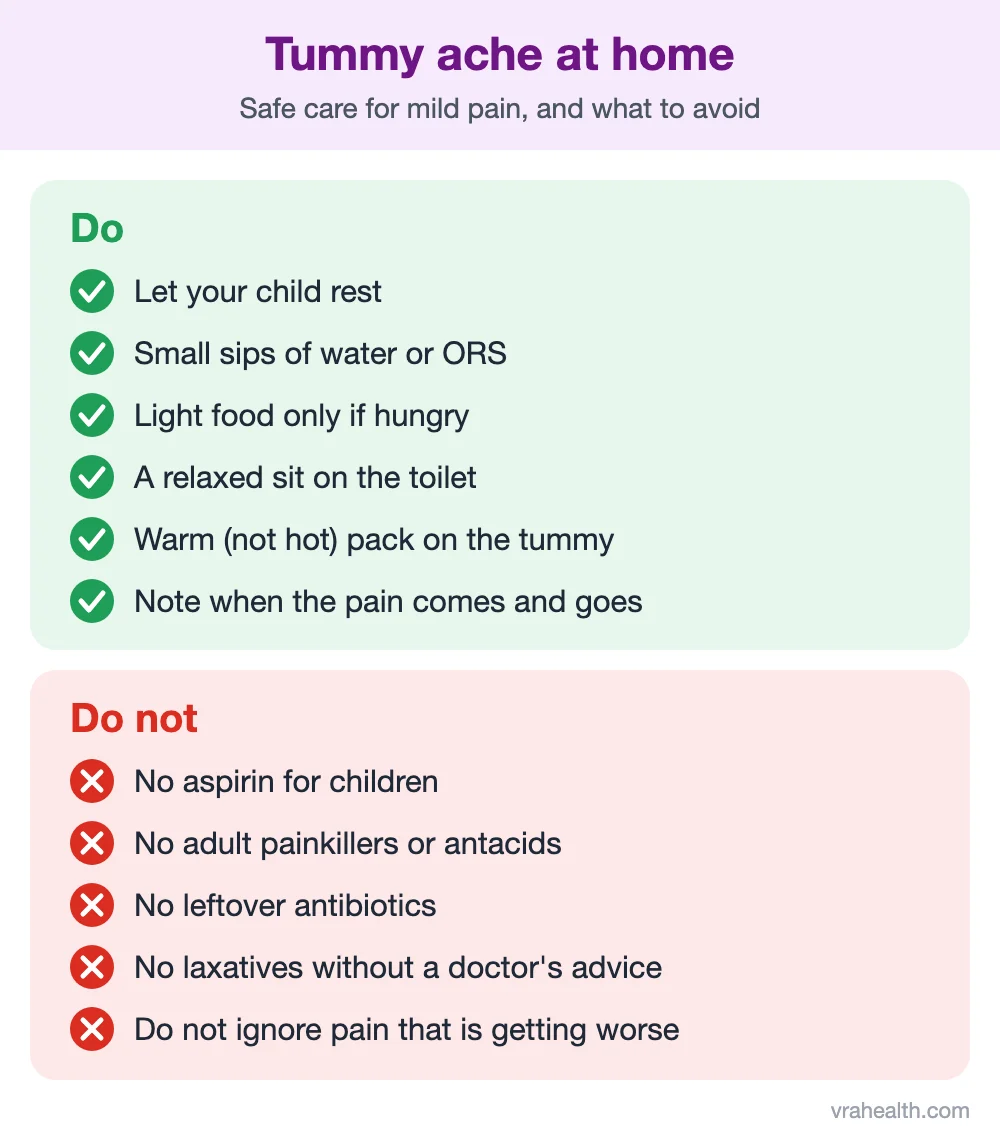
Safe home care for a mild tummy ache, and what to avoid.
Do:
- Let your child rest. Lying on the tummy or on the side with the knees bent often eases gas pain
- Offer small sips of water or ORS. Avoid fizzy drinks, tea and coffee
- Give light food if your child is hungry: rice, khichdi, idli, curd rice, banana, toast. Do not force food
- Encourage an unhurried sit on the toilet
- Place a warm (not hot) water bottle or cloth on the tummy, or give a gentle clockwise tummy massage
- If needed, give paracetamol in the correct dose for your child's weight
- Write down when the pain comes, how long it lasts, food, stools and anything that triggers it
Do not:
- Do not give aspirin to a child. It can cause a rare but serious illness called Reye's syndrome
- Do not give adult painkillers, antacids or antispasmodic tablets unless a doctor has prescribed them for this child
- Do not use leftover antibiotics. Most tummy aches are not caused by bacteria
- Do not give laxatives or anti-diarrhoea medicines without advice
- Do not keep pressing the tummy to check, and do not ignore pain that is getting worse
The American Academy of Pediatrics and MedlinePlus give similar home-care advice. If the pain is no better in 24 hours, or you are worried at any point, see a doctor. You know your child best.
Which tests might the doctor ask for?
Most children with tummy pain need only a careful history and examination. Tests are chosen based on the story, not done as a routine package. Depending on the symptoms, the doctor may ask for:
- Urine test: to look for a urine infection
- Stool test: for infection, worms, hidden blood or signs of inflammation
- Blood tests: blood count, markers of inflammation, liver tests and a coeliac test
- Ultrasound scan of the tummy: painless and without radiation. Useful for the appendix, kidneys, gallbladder and intussusception
- Endoscopy: a thin camera to look at the food pipe, stomach or large intestine, done under sedation. Needed only in a small number of children with warning signs
Normal tests are good news. They do not mean your child is pretending.
Everyday habits for a healthy tummy
- Fibre and fluids: fruit, vegetables, dals, whole grains and enough water every day
- Regular meals: do not skip breakfast. Limit fried snacks, very spicy food, chocolate, fizzy drinks and packaged juices if they trigger pain
- Toilet routine: a relaxed sit after breakfast or dinner, and no holding back at school
- Movement and sleep: an hour of active play a day and enough sleep both calm the gut
- Clean hands and safe water: wash hands with soap before eating and after the toilet
- Deworming: in areas where worms are common, the World Health Organization advises regular deworming of children. In India this is given through the National Deworming Day programme
- Talk about worries: ask gently about school, friends and bullying. Keep your child in school and in normal routines as far as possible
When should you see a pediatric gastroenterologist?
A pediatric gastroenterologist is a children's doctor with extra training in diseases of the stomach, intestine, liver and pancreas. Consider a consultation if your child has:
- Stomach pain that has been coming and going for more than 4 to 6 weeks
- Any of the red flags listed above, such as night pain, weight loss, blood in the stool or repeated vomiting
- Constipation that has not improved after a few weeks of treatment, or soiling of underwear
- Loose stools lasting more than 2 to 4 weeks
- Poor weight gain or poor growth with tummy symptoms
- Jaundice, abnormal liver tests or an abnormal scan report
- A suspected or known condition such as coeliac disease, inflammatory bowel disease, pancreatitis or Helicobacter pylori infection
- Many tests and medicines already tried, and you want a clear plan or a second opinion
How an online consultation for a child's stomach pain works
Tummy pain that keeps coming back is well suited to a video consultation, because the most important part is a detailed conversation about the symptoms, the diet, the stools, growth and earlier reports. On VRA Health you can consult a pediatric gastroenterologist online from anywhere.
Keep these ready:
- A pain diary for 1 to 2 weeks: time, place, how long, food, stools, school days or holidays
- Your child's weight and height records or growth chart
- All earlier reports, scans and prescriptions, and the names of medicines tried
- A photo of the stool or vomit if something looks unusual
- Your child with you on the call, so the doctor can see and talk to them
What a video consultation can do: work out the most likely cause, decide which tests are really needed, review reports and scans, plan treatment for constipation, functional pain, acidity and long-term conditions, and give a second opinion.
What it cannot do: the doctor cannot press on the tummy. A child with sudden severe pain or any emergency sign above needs to be examined in person at a hospital, not online.
To book: open Dr. Pandu Chouhan's profile, choose a date and time shown in your own time zone, add your child's details and reports, and pay online. The doctor calls you by video at the chosen time, and the prescription appears in your account after the call. You can also use the VRA Health app on Android or iPhone.
Living outside India? Families abroad can consult Indian specialists online in English, Hindi, Telugu or Urdu. Slot times are shown in your local time. A prescription written by a doctor in India may need to be re-issued by a local doctor before a pharmacy abroad will dispense it, and in an emergency you should call your local emergency number.
Frequently asked questions
What is the most common cause of stomach pain in children?
Constipation, gas, stomach infections and functional abdominal pain (a sensitive gut) cause most tummy aches in children. A serious cause is found in only a small number of children.
When should I worry about my child's stomach pain?
Worry if the pain is severe or getting worse, is in the lower right side, comes with green or bloody vomit, blood in the stool, a hard swollen tummy, high fever, or a child who is drowsy or will not move. These need a hospital at once. See a doctor soon if the pain lasts more than 24 hours or keeps coming back.
What can I give my child for stomach pain at home?
Rest, sips of water or ORS, light food, a warm pack on the tummy and a relaxed sit on the toilet. Paracetamol in the right dose for your child's weight is safe if needed. Do not give aspirin, adult medicines or leftover antibiotics.
Why does my child have stomach pain every day but the tests are normal?
This is usually functional abdominal pain. The gut nerves are extra sensitive, so normal digestion is felt as pain. It is real, common and not dangerous, and it improves with explanation, routine, treating constipation and sometimes medicines or therapy guided by a specialist.
Why does my child's tummy hurt around the belly button?
Pain around the belly button is the commonest type and is usually harmless, caused by gas, constipation, a stomach bug or functional pain. If it moves to the lower right side and gets worse over a few hours, think of appendicitis and go to a hospital.
How do I know if my child's stomach pain is appendicitis?
Typical signs are pain that starts near the belly button and moves to the lower right side, gets steadily worse, hurts more on walking, coughing or jumping, with loss of appetite, vomiting and mild fever. Young children may not show every sign. If you suspect it, go to a hospital without delay.
Why does my child get stomach pain after eating?
Common reasons are constipation (eating makes the bowel squeeze), overeating, acidity, and milk or other food intolerance. Note which foods and meals bring it on and show this record to the doctor.
Why does my child get stomach pain at night?
Pain at bedtime is often due to constipation, acidity or worry about the next day. Pain that wakes a child from sleep is a red flag and should be checked by a doctor.
Can worms cause stomach pain in children?
Yes, but less often than parents think. Threadworms mainly cause itching around the bottom at night. Heavy roundworm infection can cause tummy pain and poor weight gain. Regular deworming, as advised by your doctor or the national programme, takes care of this.
Can stress or anxiety cause real tummy pain?
Yes. The gut and brain are closely connected. School pressure, bullying, family changes or poor sleep can bring on real stomach pain. The child is not pretending. Calm support and keeping to normal routines help more than repeated tests.
Should my child stay home from school with tummy pain?
Keep your child home if there is fever, vomiting, loose motions or the child looks unwell. With functional pain and no warning signs, going to school is part of getting better, because long absences usually make the pain worse.
Can a pediatric gastroenterologist help through an online consultation?
Yes, for stomach pain that keeps coming back, constipation, loose stools, feeding and growth concerns, and review of reports. The doctor will tell you if your child needs an examination, a scan or a hospital visit. Sudden severe pain always needs to be seen in person.
About the author
Dr. Pandu Chouhan, MD, FIG, FIGE, is a pediatric gastroenterologist and hepatologist trained in pediatric gastroenterology at the All India Institute of Medical Sciences (AIIMS), New Delhi. He sees children with stomach, intestine, liver and pancreas problems, including long-lasting diarrhoea, inflammatory bowel disease, pancreatitis and cholestasis (liver-related jaundice), at GASTROPEDIA Speciality Clinics, Hyderabad, and consults online through VRA Health. Medical registration number: 88291. He speaks English, Hindi, Telugu and Urdu.
This article was written and medically reviewed by Dr. Pandu Chouhan on 27 November 2026.
Sources
- Korterink JJ and others. Epidemiology of Pediatric Functional Abdominal Pain Disorders: A Meta-Analysis. PLoS One, 2015.
- Hyams JS and others. Childhood Functional Gastrointestinal Disorders: Child/Adolescent (Rome IV). Gastroenterology, 2016.
- North American Society for Pediatric Gastroenterology, Hepatology and Nutrition (GIKids). Functional Abdominal Pain.
- American Academy of Pediatrics, HealthyChildren.org. Abdominal Pain in Children.
- US National Library of Medicine, MedlinePlus. Abdominal pain - children under age 12.
- The Royal Children's Hospital Melbourne. Abdominal pain.
- National Health Service (UK). Appendicitis.
- National Institute of Diabetes and Digestive and Kidney Diseases (US). Constipation in Children and Irritable Bowel Syndrome in Children.
- National Institute for Health and Care Excellence (UK). Constipation in children and young people: diagnosis and management (CG99).
- World Health Organization. Diarrhoeal disease and Soil-transmitted helminth infections.
This article gives general health information for parents and does not replace an examination by a doctor. If your child is very unwell or you are worried, go to the nearest hospital or call your local emergency number (108 in India).